Twisted crystals unlock high-efficiency deep-ultraviolet light
Scientists at the Max Planck Institute for the Structure and Dynamics of Matter (MPSD) at CFEL and an international team led by Pohang University of Science and Technology (POSTECH) have discovered that simply twisting two pieces of the crystal hexagonal boron nitride (hBN) against each other creates quantum wells that emit deep-ultraviolet light more than ten times more efficiently than the best existing semiconductor technology. First-principles calculations by MPSD theorists in Angel Rubio's department confirmed the underlying mechanism. The results are published in Science.
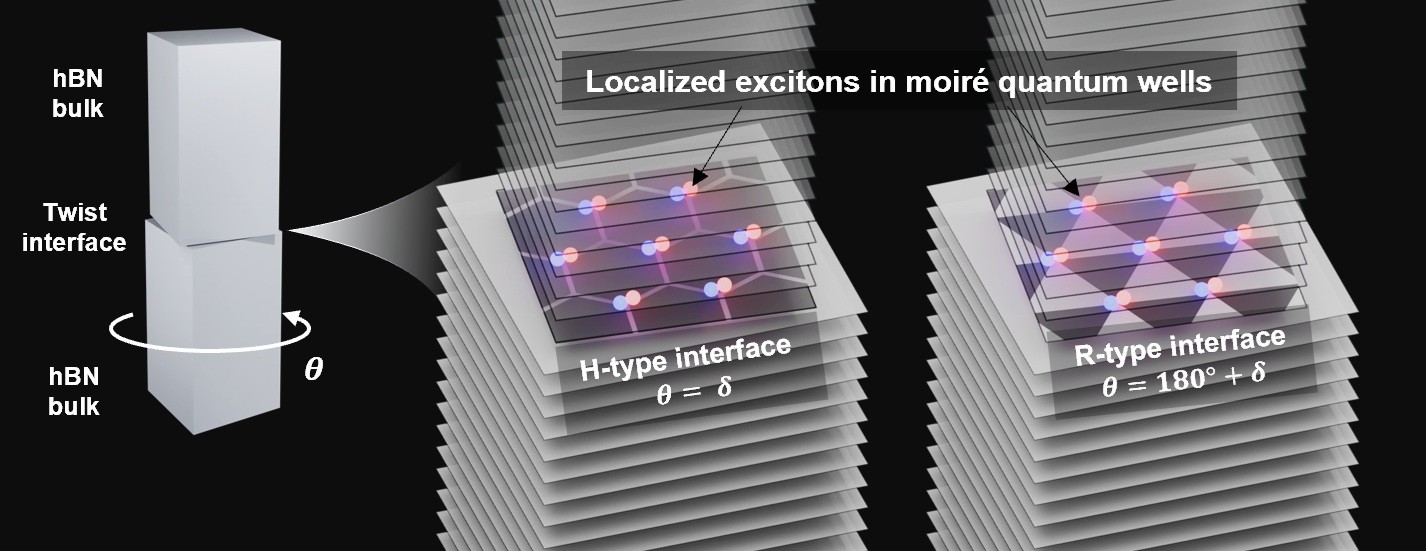
Highly efficient DUV luminescence in hBN moire quantum wells. Schematic illustration of moiré quantum wells formation at the twist interface of hBN bulks. hBN moiré quantum wells strongly localize excitons which emit remarkably strong luminescence at DUV frequencies.
@Science
Moiré superlattices — the periodic patterns that form when two regular lattices are stacked with a slight twist — have become a powerful tool for engineering quantum states in atomically thin materials. So far, however, this concept had been explored mostly in two-dimensional sheets only a few atoms thick. This new study, carried out by researchers at POSTECH together with theorists at the MPSD and colleagues at the Institute of Basic Science (IBS), RIKEN, KAIST, the National Institute for Materials Science (NIMS) in Tsukuba, the Tsientang Institute for Advanced Study (TIAS) in Hangzhou, the Flatiron Institute in New York and other institutions, now extends moiré physics to bulk crystals for the first time.
The team showed that even a single twisted interface between two thick slabs of hexagonal boron nitride can confine charge carriers in quantum wells of just one atomically thin layer, embedded within a three-dimensional crystal. Using deep-ultraviolet femtosecond laser spectroscopy, the researchers demonstrated that the periodic change in atomic stacking across the twisted interface generates strong moiré potentials, reducing the local optical bandgap by up to 300 millielectronvolts. The resulting quantum wells trap electron-hole pairs known as excitons, which recombine efficiently with the help of lattice vibrations and emit intense light in the far-UV-C range between 215 and 240 nanometers — corresponding to photon energies of 5.2 to 5.8 electronvolts (ultraviolet regime).
A key advantage of the approach is that the twist angle serves as a direct tuning knob for the light emission. The researchers fabricated samples with twist angles from less than 0.01° to more than 13° and measured the external quantum efficiency of the emitted light. At optimal angles near 3°, the so-called H-type moiré quantum wells reached external quantum efficiencies of around 0.4 — roughly twenty times higher than comparable aluminum gallium nitride (AlGaN) devices, which represent the current standard for deep-UV emitters.
The experimental findings are underpinned by extensive first-principles calculations carried out at the MPSD. Using state-of-the-art GW-Bethe-Salpeter equation (GW-BSE) methods, the theorists modelled the electronic band structure and exciton properties for all relevant stacking configurations at the twisted interface. Their calculations confirm that the moiré pattern creates domains with distinctly different bandgaps and that excitons become strongly localized in the domains with the smallest gap — precisely where the intense luminescence originates.
"Our studies show that a simple twist at the interface of two hBN crystals fundamentally reshapes the excitonic landscape," says Jonghwan Kim, principal investigator at POSTECH "The moiré potential creates nanoscale traps where excitons are confined and recombine very efficiently. What is remarkable is that this mechanism works in bulk crystals, not just in atomically thin sheets — opening the door to a much broader class of materials and device architectures."
Beyond optical excitation, the team also built proof-of-concept devices in which electrical current, injected through graphene electrodes, produced deep-ultraviolet electroluminescence from the twisted hBN regions. While the external efficiency of these first prototypes is still limited by the carrier injection scheme, the result demonstrates that moiré quantum wells in bulk crystals can in principle be driven electrically — an essential step toward practical UV-C light sources. Deep-ultraviolet light in the UV-C range has important applications in disinfection, sterilization, and photochemical processes. Current UV-C emitters based on AlGaN suffer from low efficiencies, especially at the shortest wavelengths. The new moiré quantum well concept could help overcome this long-standing bottleneck.
"This work demonstrates that interfacial moiré engineering in three-dimensional van der Waals crystals can produce optoelectronic functionality surpassing conventional semiconductor quantum wells," says Angel Rubio, director of the theory department at the MPSD. "We expect this principle to be transferable to other layered materials, potentially enabling tunable, efficient light sources across a broad spectral range for optoelectronic applications and more."